ExplainerRuble
How the Bank of Russia sets its key rate and why it matters
The key rate influences credit, deposits and demand, but its effect on inflation depends on expectations, fiscal policy and the economy's ability to supply goods.
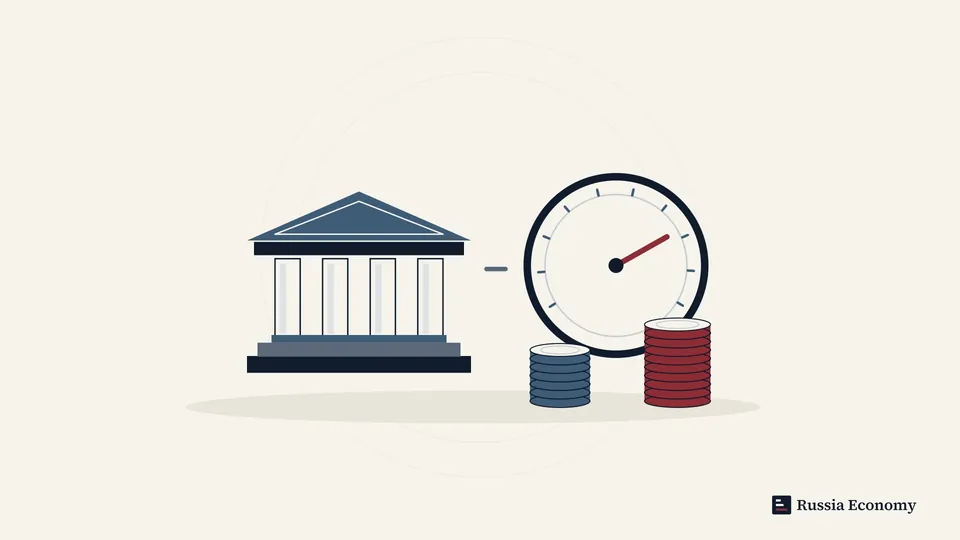
The Bank of Russia's key rate is its main signal for monetary policy. It influences the cost of short-term ruble money and, through banks and financial markets, the terms available to businesses and households. It is not the interest rate every borrower pays, and changing it does not change every price at once.
The policy objective is annual inflation of 4 percent. On September 11, 2026, the central bank kept the key rate at 14 percent. Those figures describe different things: one is the inflation target and the other is the policy instrument used to help achieve it.
Understanding the gap between them requires following the chain from the central bank's decision to money markets, loans, spending and eventually prices.
What the key rate actually represents
The key rate was introduced on September 13, 2013, as part of a redesign of the Bank of Russia's monetary-policy instruments. The framework linked the main policy signal to one-week liquidity operations and clarified the role of the interest-rate corridor.
Commercial banks continually receive and make payments. Some need short-term funds; others have funds available. Central-bank liquidity operations and the surrounding framework influence the price at which that liquidity moves through the banking system. This is the starting point of monetary transmission, not its final destination.
A bank pricing a household loan adds other considerations. Credit risk, operating costs, the loan's maturity, competition and the cost of its own funding all matter. A change in the policy rate can therefore affect different products at different speeds and by different amounts.
The reverse also applies to deposits. Banks do not simply pass the full policy rate to every saver. They may price new deposits differently from existing balances, or offer different terms depending on duration and access. The key rate establishes an important reference, not a universal retail tariff.
Why the inflation target is different from a price freeze
The Bank of Russia's monetary-policy framework sets a 4 percent annual inflation objective. That does not mean every item in the consumer basket must rise by 4 percent, or that the price level should return to where it was before an inflation shock.
Some prices rise faster, some more slowly, and some fall. The target concerns the aggregate rate of increase in consumer prices. If inflation falls from a high rate to a lower positive rate, prices are generally still increasing; they are not necessarily becoming cheaper.
A central bank also distinguishes between a temporary jump in particular prices and persistent broad pressure. A regulated-price adjustment can lift the headline index for a time. It becomes more consequential for monetary policy if it changes expectations, wage bargaining or businesses' subsequent pricing decisions.
That is why policymakers examine several indicators rather than reacting mechanically to one monthly figure. Headline inflation, measures excluding volatile components, seasonally adjusted changes and expectations each reveal something different. None should be substituted for another without naming the measure and period.
How a decision reaches households and firms
The first channel is financing. Higher borrowing costs can delay a business investment or reduce demand for purchases financed with credit. Lower rates may ease those constraints, although a borrower still needs to meet a lender's conditions and judge the project worthwhile.
The second channel is saving. More attractive deposit returns can encourage households to postpone some spending. The result depends on income, expectations and whether people believe inflation will erode those returns. Nominal rates alone do not establish the real incentive to save.
The third channel is the currency. Interest-rate differences can affect demand for ruble assets and for foreign currency, while weaker domestic demand can affect imports. The exchange rate then influences the ruble price of imported goods and components. The ruble explainer follows that relationship in more detail.
Expectations connect all three. A credible commitment to lower inflation may influence pricing and wage decisions before the full demand effect arrives. If that commitment is doubted, a given interest rate may restrain spending less than policymakers expect. Transmission is therefore partly about behavior, not only an accounting identity.
Why the effect takes time
A business with a fixed-rate loan does not necessarily face a new interest bill when the key rate changes. A household may keep an existing deposit until maturity. Projects already underway may continue even when new projects become less attractive.
Banks also have to reprice their funding and lending. The timing depends on their balance sheets and customer demand. A rapid change in new loan quotations can coexist with a much slower change in the average rate paid across all outstanding loans.
Supply conditions matter as well. Restricting demand cannot immediately create trained workers, replace an unavailable machine or shorten a delivery route. Monetary policy can help align spending with available capacity, but it is not a direct substitute for investment, infrastructure or a functioning supply chain.
Those limitations do not make interest rates irrelevant. They explain why a central bank looks ahead and why decisions may remain restrictive after a headline inflation measure starts falling. Policymakers are trying to influence future pressure through channels that do not all operate on the announcement date.
The decision process includes more than a number
The Board of Directors announces decisions on a published schedule, with additional decisions possible when conditions require them. A release explains the central bank's assessment and guidance. Summaries of discussions and forecast materials provide further context where published.
The useful sequence is to read the decision, identify what changed in the assessment, and then compare the guidance with the preceding release. A hold can carry a tighter message if policymakers become more concerned about inflation. A cut can still leave policy restrictive if the level remains high relative to the economic conditions they describe.
Forecasts should retain their labels. The bank's projection for inflation is not an observed outcome, and a projected average policy-rate range is not a promise that every scheduled meeting will produce a specific step.
Fiscal assumptions also need attention. Government spending, taxation and deficit financing affect demand and financial conditions. The same monetary setting can have a different effect under a larger fiscal impulse. The budget explainer distinguishes those fiscal decisions from the central bank's instruments.
A history of changes, with the dates kept separate
The historical series includes both long adjustment cycles and emergency moves. Selected milestones illustrate the variety; they should not be read as a formula for predicting the next decision.
| Milestone | Decision date | Key rate | Meaning |
|---|---|---|---|
| Introduction of the framework | September 13, 2013 | 5.50% | Initial policy setting |
| Low point in the pandemic easing cycle | July 24, 2020 | 4.25% | Effective July 27 |
| Emergency increase | February 28, 2022 | 20.00% | Effective the same day |
| Further tightening | October 25, 2024 | 21.00% | Effective October 28 |
| Reduction to the level held in September | July 24, 2026 | 14.00% | Effective July 27 |
| Unchanged decision | September 11, 2026 | 14.00% | No new change point |
Source: Bank of Russia announcement archive and historical key-rate series. The introduction is dated from the September 13 announcement; the daily database starts on September 17, 2013.
Separating decision and effective dates matters when matching a policy event to a loan, a market observation or another daily series. A historical change table should not insert every unchanged meeting as if it were a new rate level. Conversely, an unchanged decision remains important news even though it adds no change point to the dataset.
What the September 2026 hold said
In its September 11 statement, the Bank of Russia described continued inflation pressure and said restrictive monetary conditions were still needed. It treated the balance between demand and supply, expectations and fiscal policy as relevant to the outlook. A subsequent discussion summary added detail rather than changing the announced rate.
The distinction between annual and current inflation was central to reading the evidence. An annual rate reflects twelve months of price changes, including conditions well before the meeting. A short-period annualized measure puts more weight on the latest momentum but can be volatile. Neither is automatically the best standalone guide.
The analysis of the September hold considers that particular decision and the scheduled October 23 meeting. This guide's purpose is broader: explaining why the same headline policy level can have different implications as inflation expectations, lending and fiscal assumptions change.
What to check before drawing a conclusion
Start with the effective date and the difference between an actual decision and a forecast. Then identify which loans or deposits are under discussion: new offers, existing contracts, fixed rates and floating rates do not respond identically.
For the economy, compare the rate with evidence on inflation, demand, capacity and expectations. Subtracting the latest annual inflation number from the key rate gives a simple backward-looking comparison, not a complete measure of the expected real policy stance.
The economic indicators dashboard presents dated observations rather than pretending they all refer to the same day. That discipline is especially important around policy meetings. The key rate matters because of the behavior it changes over time, not because its announcement instantly determines every financial outcome.
Sources
- Bank of Russia, Monetary policy
- Bank of Russia, On the system of Bank of Russia monetary policy instruments (2013-09-13)
- Bank of Russia, Key rate historical database (2026-10-16)
- Bank of Russia, Publications following key rate meetings
- Bank of Russia, Bank of Russia keeps the key rate at 14.00% per annum (2026-09-11)
- Bank of Russia, Summary of the key rate discussion, September 2026 (2026-09-23)
Figures come from the listed sources for the dates and periods stated and may be revised.