Partner contentOpenSanctions
How OpenSanctions supports sanctions research and identity checks
The database connects public records, but a name match or relationship is not a legal ruling about a person or transaction.
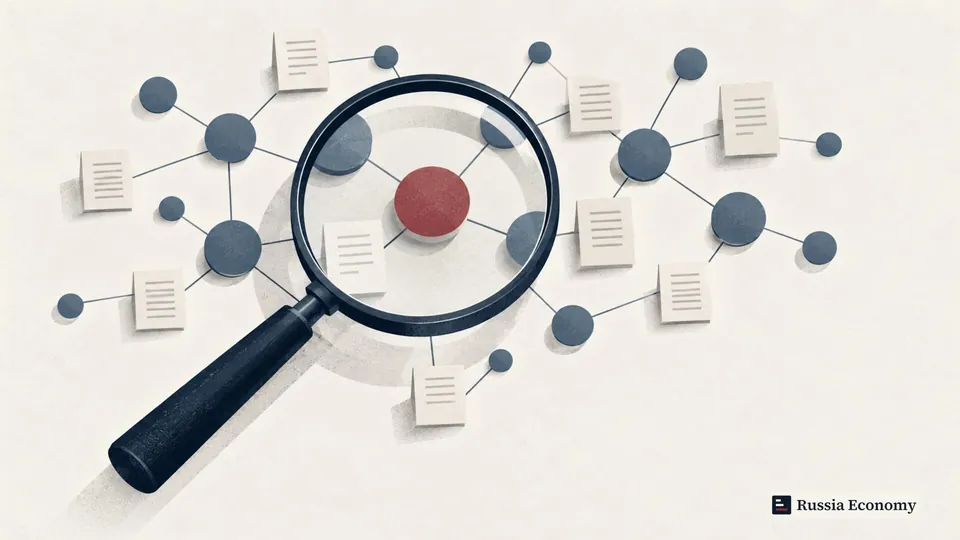
OpenSanctions organizes sanctions and related public records so people can investigate names, identities and connections across sources. For readers following Russia's trade and financial relationships, that can make a complicated record easier to inspect. A search result is a starting point for review, however, not a ruling that a transaction is permitted or that a person has committed an offense.
The service is operated by OpenSanctions Datenbanken GmbH. According to its website, its users include compliance businesses, investigative tools and research institutions. Its documentation covers website research, downloadable data and an application programming interface. These are different ways of accessing information; none removes the need to establish which entity, authority and restriction a particular record concerns.
Begin with the identity, not just the name
The OpenSanctions database and screening service brings records into a common data model. Its documentation describes people, companies and relationships, including ownership links. It also explains how information from different sources can be connected to one identity. This is useful when spelling variations or different writing systems make an ordinary name search difficult to interpret.
A Russian company can appear under a Cyrillic name, a Latin transliteration and an abbreviated trading name. A shared word does not establish that two records refer to the same business. Researchers should compare available identifiers, country information and the originating record before treating a possible match as confirmed. This is an analytical precaution, not a claim that every profile contains every identifier.
The same care helps readers interpret reporting on sanctions and Russia's economy. A restriction attached to one legal entity should not automatically be attributed to every similarly named company. Conversely, a search using only a familiar brand may miss the entity named in an official record. Record both the question asked and the identity ultimately established.
Understand why a record appears
OpenSanctions includes more than formally designated sanctions targets. Its documentation distinguishes sanctions records, politically exposed persons and other categories of interest. Inclusion in a broad database is therefore not equivalent to an asset freeze. A person may appear because of public office, a documented relationship or another source category, each of which needs its own explanation.
The site's risk-tagging documentation also distinguishes designated entities from entities connected through ownership or control. It states that its ownership-related tag can apply regardless of the percentage stake. That makes the tag useful for exploring relationships, but it must not be read as a universal legal threshold. A descriptive database label and a jurisdiction's rule are different things.
For a publishable finding, identify the authority, the source record and the reason for inclusion. Check whether the record is current and whether it describes a designation, an association or something else. When uncertainty remains, describe a possible identity match as possible. Neither a matching name nor a network connection establishes wrongdoing, and neither should be presented to readers as proof of it.
Matching supports review; it does not decide the case
The matching interface accepts a description of an entity and returns ranked candidates, according to OpenSanctions' documentation. More identifying information can help distinguish those candidates. Its guidance calls for tuning the system and human review of potential matches. A ranking is a tool for organizing attention, not a substitute for reading the records behind a result.
Consider a researcher examining a payment intermediary mentioned in a trade report. The first task is to establish the correct company. The next is to identify any relevant designation and its authority. The broader question, how the payment route works, still requires separate evidence. Russia Economy's account of Russia-China trade and payments provides context for that economic question, not clearance for a particular arrangement.
Ownership adds another layer. OFAC's published guidance explains that entities owned, directly or indirectly, 50 percent or more in aggregate by blocked persons can themselves be blocked. This is a specific US rule, not a complete statement of EU or UK rules. A business decision requires the applicable official guidance and appropriate professional review, including issues a name list alone cannot resolve.
Choose access around the actual task
OpenSanctions says its data is free for noncommercial use, while commercial use requires the relevant license or paid service. Website browsing, bulk-data use and integration through its API are not identical activities. A team evaluating the service should check the terms for its intended use instead of assuming that public availability means unrestricted business use.
Its documentation also describes running the screening service within a customer's own infrastructure. That may be relevant where an organization wants to control where counterparty information is processed. It also creates work: someone must maintain the installation, obtain the appropriate data rights and keep the data current. The availability of software does not mean an operational screening process has already been built.
For an occasional research task, begin with the profile and its source references. For repeated checking, define what should be screened, how possible matches are reviewed and how decisions are recorded. These are questions for evaluating a workflow, not a promise that the service will satisfy a particular regulator. Requirements depend on the organization, activity and jurisdictions involved.
Keep the dates and the limits visible
The service publishes documentation on updates and monitoring. A downloaded extract is a snapshot, and a saved search result does not automatically change when an authority changes its list. Researchers should retain the retrieval date and verify material conclusions against the current official record. Update frequency should be checked in the relevant dataset documentation rather than assumed to be identical across sources.
A clear name-search result also cannot answer every question about a trade or payment. Restrictions may concern activities, products, destinations or ownership rather than an exact name. The distinction helps explain why Russia's banking system needs more analysis than a list of designated institutions. A bank's role in the economy and the legal treatment of a particular transaction are separate questions.
OpenSanctions can make public records easier to connect and inspect. Its strongest use in economic research is to support a traceable account: who is involved, what the source actually says and what remains unresolved. Keep that account separate from a legal conclusion. The outcome should be a better-supported question or finding, not an unsupported assurance that a relationship is safe or prohibited.
Partner content. This article is about OpenSanctions and is separate from Russia Economy's editorial coverage.