NewsTrade & Sanctions
Russia's grain harvest nears completion as wheat export forecasts fall
Official harvest updates, industry export forecasts and a temporary zero duty describe different parts of Russia's 2026 grain outlook.
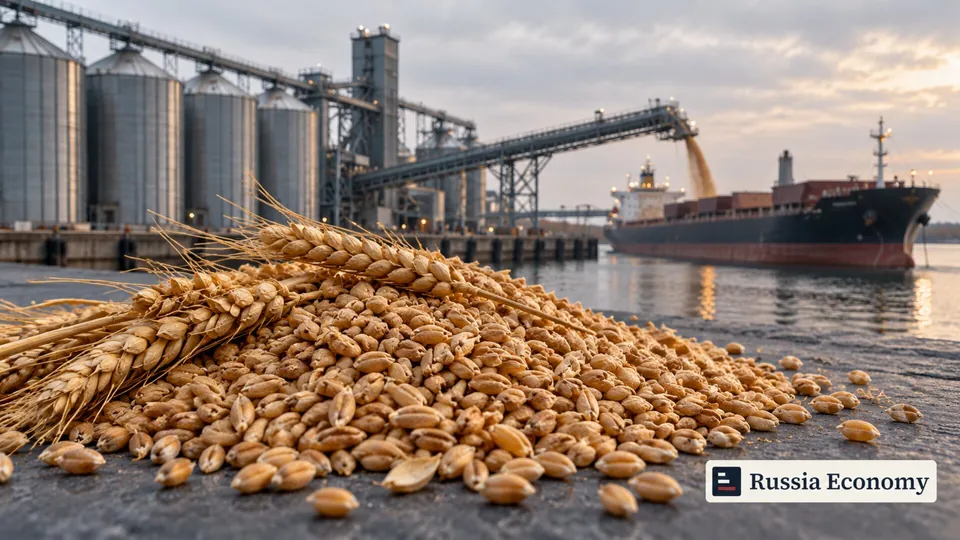
Russia had harvested 135 million tonnes of grain in bunker weight by October 28, 2026, Agriculture Minister Oksana Lut said, according to Finmarket. She retained the ministry's forecast of 140 million tonnes for the year. Neither figure is a final Rosstat harvest total, and the export outlook remains a separate calculation: IKAR's latest forecast puts wheat shipments in the 2026/27 season at 39.5 million tonnes.
The distinction matters because grain collected from fields, grain available after processing and grain shipped abroad measure different stages. A large harvest does not by itself establish how much exporters will sell, when shipments will leave or whether those sales will be profitable.
The harvest figures use different measures
Lut said the wheat harvest was complete while corn harvesting continued. Her 135 million tonne figure is an official statement about progress, reported by Finmarket on October 28, rather than a published final statistical result. The 140 million tonne figure remains an official forecast.
The Bank of Russia's October regional economy report, published on October 14, explains the measurement issue. Bunker weight is the weight before processing. Clean weight, used in Rosstat's harvest statistics, excludes waste and reflects drying. Subtracting an interim bunker weight figure from a final clean weight forecast would therefore not give a reliable measure of how much harvesting remains.
That report recorded more than 126 million tonnes of grain, including 93 million tonnes of wheat, in bunker weight at the beginning of October. It separately cited the Agriculture Ministry's 140 million tonne grain forecast. Those earlier progress figures must not be presented as the latest October 28 harvest update.
Independent estimates also differ. On October 29, IKAR director Dmitry Rylko told Agroexpert that the institute expected 136.5 million tonnes of grain, including 88 million tonnes of wheat. These are industry forecasts, not official final results. Their difference from the ministry's projection does not establish which forecast will prove correct.
Wheat export forecasts describe a different period
IKAR put potential grain exports at 49 million tonnes in the 2026/27 agricultural season, including 39.5 million tonnes of wheat. Agroexpert reported that its earlier October forecasts were 52.8 million tonnes and 42 million tonnes respectively. The revision concerns expected seasonal shipments, not a reduction in grain already exported.
A more immediate estimate comes from Rusagrotrans. In a report published on October 30, Agroexpert cited the company's analytical center as expecting wheat exports of 10.3 million tonnes in July through October, compared with 16.9 million tonnes a year earlier. The source described the decline as 39.1 percent. This is a preliminary industry estimate that includes an October period not yet complete on the publication date.
These numbers should not be spliced into a single series. IKAR's figure covers the whole agricultural season; Rusagrotrans covers its first four months. Neither is a final customs total for the same period. The major exports explainer places grain within Russia's wider trade structure, without treating all commodity exports as one market.
The temporary zero duty overrides calculated rates
Government Resolution No. 1194, dated September 19, 2026, sets a zero export duty for the covered wheat, meslin, barley and corn exports outside the Eurasian Economic Union from September 1 through December 31, 2026. The decree is reproduced by Garant; the Bank of Russia's October report also records the zero duties through year end.
The distinction between a calculated rate and an applicable rate is material. The Agriculture Ministry's rate schedule, reproduced by ConsultantPlus, continues to show formula calculations, but its footnote specifies that the applicable duty is zero under Resolution No. 1194. A positive number in that schedule is therefore not evidence that exporters currently pay that amount.
This temporary duty measure does not establish the terms for 2027. Nor is a duty rate an export quota. The verified change described here concerns the charge on covered exports, not a newly announced volume allocation for the following season.
Export tonnage cannot establish profitability
Russia Economy's analysis: harvest, shipment and duty figures answer different questions. Tonnes indicate physical volume. Export revenue also depends on realized prices; profitability additionally requires costs such as procurement, transport, handling, financing and insurance. A zero duty supplies only one element of that calculation.
The same caution applies to domestic supply. Production is not identical to the amount available for export, because domestic use and changes in stocks also enter the balance. Without matching data on those components, subtracting an export forecast from a harvest forecast cannot establish a surplus available to any particular buyer.
Readers following the outlook can use the economic indicators tool for broader context. The next decisive comparisons are final harvest figures on a consistent weight basis and completed shipment totals for matching periods. Until then, the defensible picture is a harvest nearing completion, differing forecasts and a temporary zero duty, with no demonstrated conclusion about exporter profits.