ExplainerTrade & Sanctions
How sanctions have affected Russia's economy
Sanctions restrict particular financial, trade and technology channels; judging their effects requires separating legal measures, adaptation costs and uncertain counterfactuals.
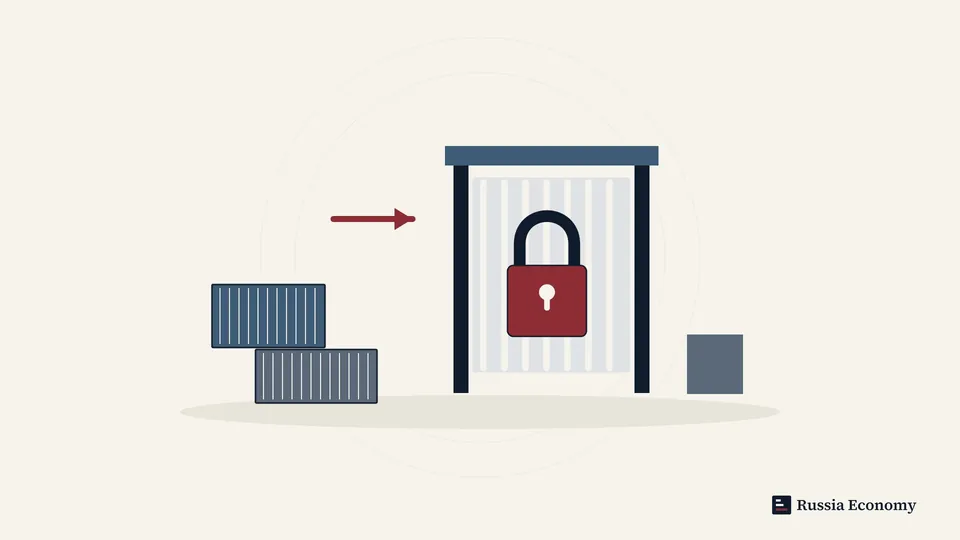
Sanctions have changed Russia's access to foreign finance, technology, services and markets. They have not stopped every international transaction or every source of economic growth. Both statements can be true because the restrictions have different targets and because firms and governments respond to them.
The most useful assessment does not ask whether sanctions have simply worked or failed. It asks which measure pursued which objective, what behavior changed, what costs arose and what would plausibly have happened without it. The last question is a counterfactual, not a statistic that can be directly observed.
Russia's continued production and trade therefore do not settle the debate. Nor does the announcement of another sanctions package establish its economic effect before evidence of implementation appears.
The sanctions framework grew in stages
The European Union, the United States and other jurisdictions introduced measures in response to Russia's actions in Ukraine in 2014. Russia's full-scale invasion of Ukraine, launched in February 2022, brought a much broader set of restrictions, followed by repeated amendments, new designations and enforcement measures.
The instruments differ. Some restrict dealings with named individuals or entities. Others limit categories of goods, services, financing or investment. Measures can include exceptions, transition periods or licensing provisions. A headline describing a sanctions package is not a substitute for the particular legal text.
The Council of the European Union's sanctions overview explains the EU framework and its evolution. It should be read as the EU's account of its measures and objectives, not as independent proof of every claimed economic outcome.
Jurisdictions also differ. A transaction's treatment under one country's rules does not establish its treatment under another's. Describing all restrictions as a single global embargo hides the differences that explain much of the resulting trade and financial behavior.
Reserve restrictions were not the same as confiscation
On February 28, 2022, the US Treasury announced prohibitions on transactions involving the Bank of Russia, the National Wealth Fund and the Finance Ministry. Parallel international measures constrained the use of reserve assets held within relevant jurisdictions.
Restrictions on access or transactions can make an asset unavailable for its intended purpose while leaving the legal ownership question distinct. Immobilization, freezing, use of earnings and confiscation are different legal and economic actions. They should not be used as interchangeable labels.
The immediate economic issue was the usability of external buffers. A large published reserve total does not tell readers how much can be mobilized through a particular payment system or jurisdiction. The composition and location of assets become important when restrictions apply.
That distinction also matters for the National Wealth Fund. The fund's reported total, its liquid component and the wider central bank's international reserves are separate concepts. Adding them indiscriminately can double count assets or imply access that the legal and operational setting does not provide.
SWIFT is a messaging network, not the entire banking system
Restrictions involving SWIFT affected the ability of designated banks to use an important international financial messaging service. Messaging is essential to many transactions, but a message is not itself the movement of money or a guarantee that settlement is permitted.
A payment also depends on banks, accounts, counterparties, currencies, documentation and the relevant restrictions. Removing access to one network can create serious friction, while a transaction through another channel may still be prohibited for a different reason. Conversely, a permitted transaction can fail operationally if the institutions involved decline to process it.
Banks may respond to uncertainty by restricting business beyond the minimum legal requirement. Compliance costs and the risk of enforcement can affect their commercial decisions. These responses can interrupt trade even when the headline measure does not name every affected exporter or importer.
The distinction is explanatory, not guidance on bypassing rules. A reader should be wary of any claim that changing the messaging system or settlement currency makes a restricted transaction automatically lawful or straightforward.
Technology controls work through inputs and time
Export restrictions can limit access to machinery, components, software and specialized services. Their effects may not appear immediately in aggregate production because firms can use inventories, existing equipment or alternative suppliers for a period.
Maintaining current output and expanding future capacity are different tests. A company may keep a production line running while delaying an upgrade. A substitute component may be available but less efficient, more expensive or harder to service. These costs can emerge in productivity and investment rather than in an immediate disappearance of output.
This also complicates the measurement of imports. Goods arriving through a different partner may restore physical access while changing the delivered cost and time required. Trade values alone cannot identify the quality of the goods, the ultimate producer or whether a restricted item was involved.
Evidence should therefore match the claim. A customs total can support a statement about reported trade value. It cannot, without additional information, prove successful evasion, identical technical capability or the absence of a sanctions effect.
Oil restrictions combine market access and services
The EU's seaborne crude import restrictions began on December 5, 2022, followed by petroleum-product restrictions on February 5, 2023. The oil price-cap framework added conditions on access to covered maritime services for certain Russian oil trades with third countries.
An import embargo and a service-related cap are not the same policy. One removes or restricts a destination; the other seeks to affect transactions beyond that destination through access to services. The original crude cap was $60 per barrel, but that historical number should not be treated as an unchanged rule across all jurisdictions and dates.
Russia redirected substantial oil trade toward Asian buyers, as the EIA's country analysis describes. That demonstrates adaptation in destination patterns. Assessing the cost requires examining realized prices, freight, finance, insurance and the reliability of delivery, not simply whether a tanker sailed.
The energy explainer follows those mechanisms. It also explains why gas pipelines and seaborne oil cannot be treated as equally flexible export systems.
Growth does not identify the counterfactual
GDP can rise despite sanctions if other sources of demand or supply expansion outweigh some of their effects. Government spending, commodity conditions and redirected trade can support activity. The observed growth rate does not reveal how much higher or lower output would have been under a different external environment.
Equally, a slowdown cannot be attributed entirely to sanctions without considering other influences. Interest rates, labor constraints, fiscal choices, global demand and damage to infrastructure can affect output at the same time. Causal attribution requires more than placing two developments beside each other on a chart.
BOFIT, the Bank of Finland's emerging-economies institute, emphasized structural constraints and an uneven economy in its October 5, 2026 assessment. It projected modest growth under explicit assumptions rather than presenting immediate collapse as an observed fact. Its forecast remains an independent assessment subject to uncertainty, not a guaranteed outcome.
The guide to Russia's economic structure explains why expanding state-related activity can coexist with pressure elsewhere. The composition of growth is often more revealing than a single national total.
Enforcement announcements show action, not completed results
On October 15, 2026, the EU Council listed additional people and entities it accused of helping circumvent sanctions, including participants associated with oil trade, logistics and payments. The announcement establishes that the Council acted and states its reasons; the allegations should remain attributed to that institution.
To assess the subsequent economic effect, researchers would need evidence about transactions, counterparties and any change in behavior. A designation may discourage counterparties, raise compliance costs or redirect business, but the magnitude and timing cannot be inferred from the number of names on the list alone.
The report on those listings distinguishes the measure from the claims supporting it. That is especially important when an announcement names private entities: being listed is a verifiable regulatory event, while the underlying conduct must be described with its evidentiary status intact.
Counting sanctions packages can measure policy activity. It is not a direct measure of foregone export revenue, reduced military production or changed political decisions.
Restricted information makes careful comparison more important
Russian public statistical releases have become less detailed in some areas since 2022. International researchers consequently use combinations of official releases, trading-partner statistics and sector-specific evidence. Those substitutes have different definitions, coverage and publication lags.
Trading-partner data can help identify reported imports from or exports to Russia, but differences in freight valuation, timing and country-of-origin rules complicate reconciliation. Shipping estimates can add information on physical flows while still leaving destination or price uncertainty.
A missing series should not be filled with a confident invented number. Nor should incomplete coverage be used to dismiss every available official observation. The useful approach is to specify what a source measures, test it against relevant alternatives and preserve the remaining uncertainty.
Sanctions analysis is strongest when it separates three questions: what the rules restrict, how economic actors respond, and what measurable consequences follow. Russia's adaptation is part of that analysis, not a reason to stop it. The same is true of the costs that adaptation itself creates.
Sources
- Council of the European Union, EU sanctions against Russia explained
- Council of the European Union, Timeline of sanctions against Russia
- US Treasury, Treasury prohibits transactions with the Central Bank of Russia (2022-02-28)
- US Energy Information Administration, Russia country analysis brief (2025-07-24)
- Council of the European Union, Closing loopholes: Council lists individuals and entities for circumventing EU sanctions (2026-10-15)
- Bank of Finland Institute for Emerging Economies (BOFIT), BOFIT forecast for Russia 2026 to 2028, 2/2026 (2026-10-05)
Figures come from the listed sources for the dates and periods stated and may be revised.