ExplainerEconomy
How Russia's economy works: resources, the state and the ruble
Russia's economy combines commodity exports, a large domestic service sector and an influential state; the links between them matter more than any single headline.
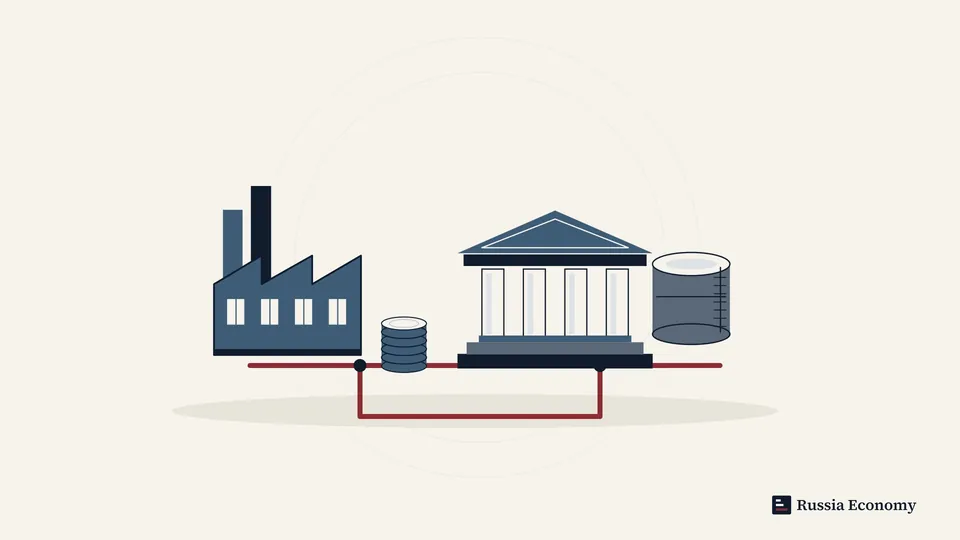
Russia's economy is not simply an oil business with a government attached. Households buy services, manufacturers produce goods, banks allocate credit and the state collects taxes and buys output. Oil and gas nevertheless have an unusually important connecting role: they generate foreign earnings that affect the ruble, public revenue and the capacity to pay for imports.
Understanding those connections explains why two apparently contradictory headlines can both be true. Export volumes can hold up while government energy revenue weakens. Output can grow while households face expensive credit. A stronger currency can help importers while reducing the ruble value of an exporter's dollar receipts.
The useful question is not whether the economy is simply strong or weak. It is which parts are expanding, who is paying, and what constraints that activity creates elsewhere.
Production is broader than exports
An economy's output and its exports are different things. A restaurant meal sold inside Russia adds to domestic production but earns no foreign currency. An exported barrel of oil does both. The composition of exports therefore cannot be read as the composition of gross domestic product, or GDP.
Rosstat's national accounts organize production across activities including extraction, manufacturing, construction, transport, trade and other services. The expenditure view asks a different question: how much output is absorbed by households, government, investment and net exports? Both views describe the same economy from different directions.
That distinction also prevents double counting. A steelmaker's total sales include the value of materials and energy bought from other firms. GDP counts the additional value created at each stage, rather than adding every company's gross revenue together. Claims that a handful of firms represent most of the economy often fail this basic comparison.
Nor does GDP measure whether output is useful to a particular household. An increase in government procurement contributes to measured activity, but it need not improve the availability of consumer goods or housing. Output, living standards and productive capacity are related concepts, not interchangeable labels.
The state operates through several channels
State influence is not confined to ministries. It can operate through ownership of companies, public procurement, bank lending, infrastructure decisions, regulation and transfers to households or regions. A private supplier may depend heavily on government orders without being state-owned itself.
That makes a single percentage for the state's economic footprint difficult to interpret. An IMF study published in 2019 examined different measures of public-sector size and influence. Its analysis is a useful warning against equating state-owned firms' revenue with the state's contribution to GDP. Ownership, employment, expenditure and value added answer different questions.
The distinction has practical consequences. A government contract can support a manufacturer's order book, but the manufacturer still needs workers, components, electricity and financing. If those inputs are scarce, larger orders may push up wages and prices rather than produce a proportional increase in output.
State influence can also redistribute pressure. Subsidized lending may protect selected borrowers from the full cost of monetary tightening, while firms outside the program face higher commercial rates. Reading the aggregate credit number without knowing who received the loans misses that uneven transmission.
Energy connects foreign trade to the budget
The US Energy Information Administration's Russia country analysis describes the country's large oil and gas industries and changing export routes. These sectors matter not only because of their production, but because external sales bring in currencies used for international payments.
Consider a simplified exporter receiving foreign currency. Its ruble revenue depends on the sale price, the volume shipped and the exchange rate at which receipts are converted. The government then collects revenue according to applicable taxes and other rules. A change in any one of those variables can alter the fiscal result.
This is why an international oil benchmark is not a complete Russian revenue indicator. Russia's realized export prices, quality differentials, freight costs, payment arrangements and tax treatment also matter. The same global benchmark can produce different net proceeds for different shipments.
Gas adds another distinction. Pipeline routes are tied to physical networks and contracts. Cargoes of liquefied natural gas are more mobile, but require liquefaction plants, suitable ships and receiving infrastructure. The oil and gas explainer examines why redirecting oil and replacing a lost pipeline market are different tasks.
The ruble is a price and a transmission mechanism
The ruble links domestic spending to the cost of foreign goods. When more rubles are needed to buy a foreign currency, an imported machine can become more expensive even if its foreign-currency price is unchanged. The increase may reach customers immediately, later, or only partly, depending on inventories and competition.
A weaker ruble can also raise the domestic-currency value of export earnings. That does not mean every exporter gains: imported equipment, foreign-currency obligations and transport costs can offset the benefit. Currency changes redistribute income and costs rather than delivering a universal advantage.
Russia moved to a floating exchange-rate framework in November 2014, according to the Bank of Russia. Floating does not mean that policy is irrelevant. Interest rates, foreign-exchange operations, restrictions on capital flows and the rules governing export receipts can all change supply and demand in the currency market.
Official exchange rates also differ from executable customer prices. A reference rate can help compare values; it does not guarantee that a bank, payment service or cash exchange will offer the same conversion. That matters especially when access to particular currencies or payment channels is restricted.
Fiscal policy and monetary policy can pull differently
The federal budget determines revenue and spending, while the central bank uses monetary policy to influence inflation and financial conditions. They interact, but they are not the same decision-making process. Government spending may support demand while high interest rates discourage some private borrowing.
The Bank of Russia targets annual inflation of 4 percent. On September 11, 2026, it kept its key rate at 14 percent, indicating that returning inflation to target still required restrictive conditions. The target is a policy objective; the interest rate is an instrument used in pursuing it.
An increase in public demand is not automatically offset by a rate increase of a particular size. The effect depends on spare capacity, financing, expectations and how private borrowers respond. The key rate guide explains those channels without treating policy as a mechanical formula.
The federal budget guide makes a corresponding distinction between a spending plan and actual execution. A deficit may be financed through borrowing or assets; it does not by itself reveal the economy's growth rate, inflation outlook or immediate ability to pay.
War and sanctions change the composition of activity
Russia's full-scale invasion of Ukraine, launched in February 2022, brought a major expansion of international sanctions and a different pattern of state demand. Restrictions on finance, technology and trade affected economic choices, while firms and banks sought alternative suppliers, buyers and payment arrangements.
Adaptation should not be confused with absence of cost. A replacement shipment may arrive through a longer route or require more working capital. A locally produced component may fill a gap but differ in quality, price or scale. Equally, a disrupted trade relationship does not prove that all output in the affected sector disappeared.
The sanctions explainer separates measures from measured outcomes. The relevant comparison is often the economy's trajectory against a plausible alternative without the restrictions, not simply whether GDP remained above zero. That counterfactual is uncertain and should not be dressed up as an observed statistic.
The distributional question matters too. An expanding supplier to the state and a small importer facing payment delays can experience the same national economy very differently. Aggregate figures can conceal that divergence without being meaningless.
Read a group of indicators, not a verdict
Start with the period and definition. Real GDP growth removes price changes; nominal revenue does not. December inflation compares two endpoints, while annual-average inflation compares two sets of months. Annual unemployment is not the same observation as a single month's reading.
Then ask whether the figure is an outcome, an estimate or a forecast. Rosstat's 2025 GDP release, for example, is an estimate of a completed year and remains revisable. A government growth projection for 2027 is a statement about an uncertain future, however precise its decimal places appear.
The most useful sequence runs from production and employment to prices, credit, trade and public finances. It tests whether demand is supported by improving capacity or increasingly constrained resources. It also asks whether apparent improvements reflect a lasting change or an unusually weak comparison period.
Russia's economy becomes easier to understand when these measures are kept separate and then connected carefully. Resources help finance the system, the state shapes its priorities, and the ruble and interest rates transmit pressure through it. None of those elements is a complete explanation on its own.
Sources
- US Energy Information Administration, Russia country analysis brief (2025-07-24)
- International Monetary Fund, The Russian state's size and its footprint: have they increased? (2019-02-08)
- Rosstat, National accounts: volume indices
- Rosstat, Second estimate of GDP for 2025 (2026-04-10)
- Interfax, Rosstat confirms 1% Russian GDP growth in 2025 (2026-04-10)
- Bank of Russia, Monetary policy
- Bank of Russia, Bank of Russia keeps the key rate at 14.00% per annum (2026-09-11)
- Bank of Russia, On Bank of Russia exchange rate policy (2014-11-10)
- Council of the European Union, EU sanctions against Russia explained
Figures come from the listed sources for the dates and periods stated and may be revised.