ExplainerEnergy
Russia's gas exports: pipelines, LNG and the shift away from Europe
Gas can reach a new market only through operating infrastructure, suitable contracts and commercially workable routes.
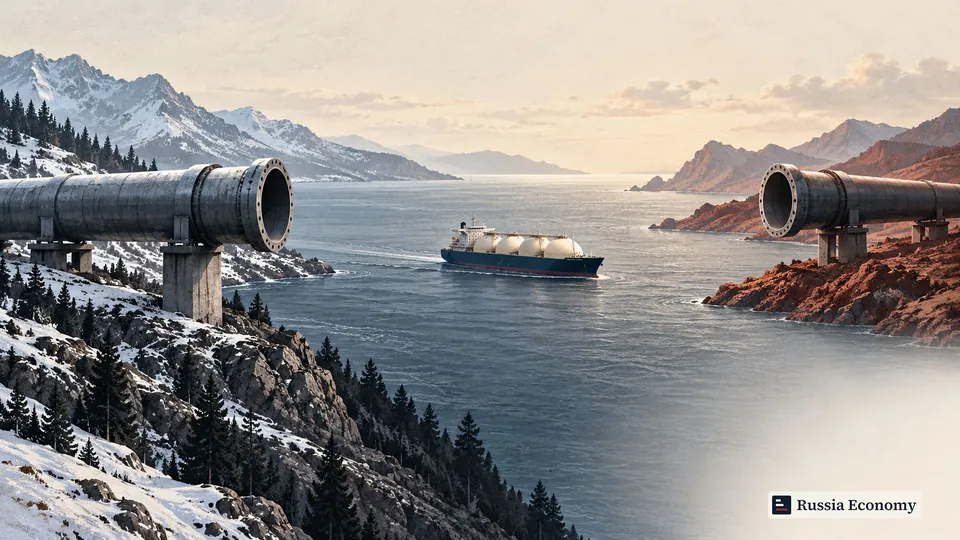
Russia cannot replace lost European pipeline sales simply by changing a shipment's destination on a contract. Pipeline gas follows connected fields, compressor stations and delivery networks. LNG can travel by ship, but it first requires liquefaction capacity, suitable vessels and receiving terminals. The economics of redirecting gas depend on which infrastructure exists, which market it reaches and what customers have agreed to buy.
That makes the shift away from Europe more complicated than a comparison of national demand totals. China is a large market, but demand there does not create an immediate physical connection to every Russian gas field. The distinction is central to Russia's economic relationship with China and to the different outlooks for pipeline exports and LNG.
Europe's routes changed in distinct stages
The damage to Nord Stream in September 2022 removed major infrastructure from normal commercial use. The reported leaks and the pipelines' operating condition should be distinguished from allegations about responsibility. This article does not attribute the damage to a particular actor. Establishing physical disruption does not require adopting an unproven explanation of who caused it.
Another change came on January 1, 2025, when Russian gas transit through Ukraine ended following the expiry of the relevant agreements. That was a change in an operating transit arrangement, not the destruction of every pipeline crossing the country. Physical infrastructure and a legally available commercial route are different assets.
TurkStream remained an important route for Russian pipeline deliveries toward southeastern Europe. Its role should not be used to imply that the earlier European network continued unchanged. Routes have different capacities, landing points, onward connections and customers. A surviving route can carry substantial gas without being able to reproduce all the functions of routes that stopped operating.
These changes followed Russia's full-scale invasion of Ukraine, launched in February 2022, and a wider European effort to diversify supplies. Import restrictions, buyer decisions, contract disputes, infrastructure damage and the expiry of transit agreements are distinct developments. Combining them under a single explanation can obscure which event changed a particular flow.
Why Power of Siberia is not a replacement switch
Power of Siberia links an eastern Siberian resource base with China. The producing areas and network differ from the western system that historically supplied much of Europe. Gas cannot move between those systems merely because it belongs to the same exporting country or corporate group. Connections, processing facilities and capacity must physically exist.
A useful comparison therefore starts with the relevant field and pipeline, rather than an exporter-wide production total. Unused capacity in one location does not necessarily relieve a bottleneck elsewhere. Similarly, additional demand from a Chinese customer is not evidence that gas stranded in a western network has found an equivalent outlet.
Power of Siberia 2 is a separate proposed infrastructure project. Statements about negotiations or agreements need to be read alongside what has been disclosed about price, financing, construction and commissioning. An announced project is not an operating export route. A projected commissioning date remains a plan until construction and operating evidence support it; undisclosed commercial terms should remain undisclosed rather than being reconstructed as fact.
Even a completed new connection would not automatically reproduce the economics of an old market. Distance, capital expenditure, contract pricing and bargaining power influence the return to the supplier. Replacing a volume and replacing its previous revenue are different objectives. A report about capacity alone cannot establish either the realized sales price or the project's profitability.
LNG is movable, but not unconstrained
Liquefied natural gas is cooled so it can be transported by specialized ship and converted back into gas at its destination. This makes it less dependent on a single continuous pipeline. It does not make every producing field immediately available to every buyer. Liquefaction plants and terminals impose their own limits.
Project nameplate capacity describes a designed annual production capability. Actual output depends on operating conditions, maintenance, available feed gas and equipment. Exports require loading, vessels and buyers as well. A plant can have substantial nominal capacity while shipments remain below it; quoting the former as if it were recorded exports overstates what has happened.
Arctic LNG 2 illustrates why project-level restrictions matter. The project has been targeted by foreign sanctions, including UK measures announced in February 2024. A designation changes the legal and commercial conditions around a project, but its effect on realized output must be measured separately. Technical capacity, vessel availability and a sanctioning authority's claims should not be treated as interchangeable evidence.
The same distinction applies to Russian LNG as a whole. A restriction on one project is not proof that every Russian LNG cargo is prohibited everywhere. Jurisdiction, contracting party, vessel and destination remain relevant. Equally, evidence that a cargo was delivered does not establish that sanctions have no effect on costs, investment or future expansion.
The EU phase-out now has an adopted timetable
The EU adopted its gas-import phase-out regulation on January 26, 2026. The Council's explanation of the adopted rules distinguishes pipeline gas from LNG and shorter contracts from longer ones. These are enacted provisions with transition periods, rather than the earlier proposal's timetable.
The general prohibition began on March 18, 2026. For qualifying existing short-term contracts, the transition ended on April 25, 2026 for LNG and June 17, 2026 for pipeline gas. Treating those dates as one universal cutoff would conceal the contractual distinctions written into the measure.
For qualifying long-term contracts, the LNG prohibition applies from January 1, 2027. The pipeline deadline is September 30, 2027, with a possible extension to November 1, 2027 where the specified storage condition applies. The potential extension is conditional; it should not be presented as an automatic later deadline for every importer.
The regulation also contains monitoring and authorization provisions. Origin matters because gas can be traded through several intermediaries before delivery. The legal timetable concerns imports into the EU; it does not mean Russian production ends on those dates or that other markets apply identical rules. Readers can connect this distinction with the broader explanation of sanctions and Russia's economy.
Gazprom's results do not measure only European gas sales
Gazprom's consolidated financial results cover a wider group than a single export route. According to results reported on April 30, 2026, the group's 2025 net profit attributable to shareholders under international accounting standards was about 1.3 trillion rubles, up about 7 percent. That is a group-level accounting result, not a measure of European pipeline profitability.
Revenue, operating earnings, net profit and cash flow can move differently. Exchange-rate valuation and the results of different subsidiaries can affect the bottom line without representing a matching change in physical gas deliveries. Comparing a group profit figure directly with a pipeline-flow series would merge financial and operational evidence.
Accounting scope also matters when comparing reports. A parent company's Russian-standard accounts are not the same as consolidated international-standard accounts. An annual result cannot be substituted for an interim period without explanation. Where a route-by-route breakdown of volumes and revenue is not published, any precise reconstruction would be guesswork.
What would demonstrate a successful export shift
Evidence of a sustained shift would combine delivered volumes, realized prices, reliable operating infrastructure and the costs of developing the new route. No single announcement supplies all those elements. A new contract can be commercially important before first gas flows, while an operating route can carry more gas without matching a previous market's margins.
Comparisons should preserve their units. LNG tonnes and pipeline cubic meters require a stated conversion methodology before they can be combined; different gas compositions can affect the conversion. Capacity should retain its annual label, while recorded deliveries need an actual reference period. Leaving those distinctions visible is more informative than constructing a misleading total.
The result is a more differentiated picture than either complete isolation or effortless substitution. Russia retains operating export infrastructure and buyers, but the available routes are not equivalent. The explanation of oil and gas in Russia's economy provides the fiscal context: export earnings depend on price and cost as well as quantity. The evidence needed to judge the shift is a sequence of completed projects, actual deliveries and financial results, rather than the size of another market alone.