AnalysisBusiness
Russia's September producer prices rise 2.5 percent as extraction outpaces manufacturing
Rosstat's October 21 release shows sharply different price movements across industries, making the headline increase an incomplete guide to business costs.
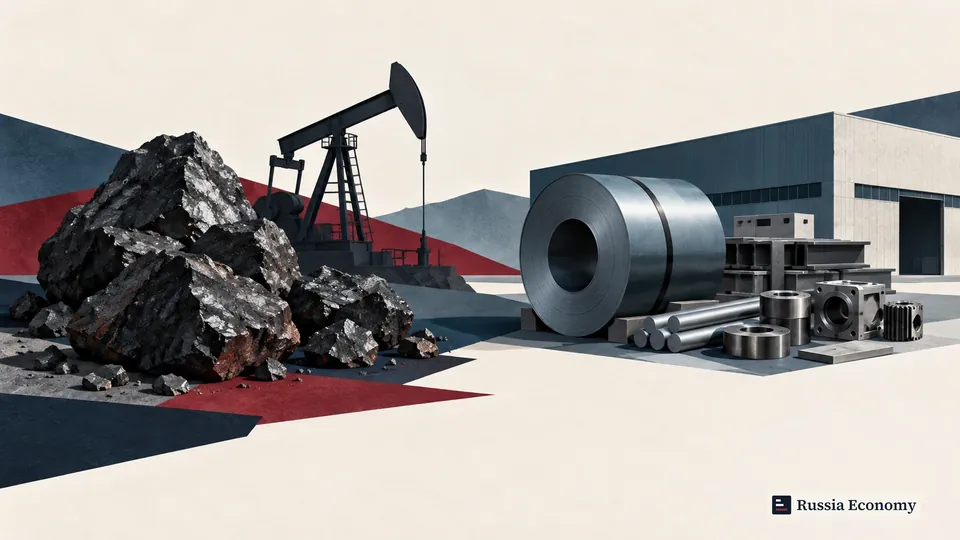
Preliminary official data from Rosstat show that Russian industrial producer prices rose 2.5 percent in September 2026 from August, with extraction prices rising 10.5 percent and manufacturing prices increasing 0.8 percent. Published on October 21, the release points to a marked difference between sectors. Russia Economy's analysis is that the headline does not describe a uniform increase in the prices charged by Russian factories.
The comparison period changes the message
Rosstat's September producer-price release covers industrial goods intended for sale on the domestic market. Its preliminary official indices put the overall price level 10.5 percent above December 2025 and 8.6 percent above September 2025. For January through September 2026, the average was 3.8 percent higher than in the corresponding 2025 period.
Our analysis is that these figures answer different questions. The monthly increase describes the movement from August; the December comparison measures the change from the end of the previous year. The twelve-month comparison and the nine-month average use different reference periods again. They cannot be substituted for one another to make the increase appear larger or smaller.
In the official table, an index of 102.5 means a 2.5 percent increase from the stated base, not a 102.5 percent price increase. Russia Economy converts the published indices into changes by subtracting 100. This arithmetic is transparent, but it does not create an additional observation or identify a cause.
That distinction also separates prices from production. In our analysis, a higher price index does not establish that more goods were produced or sold. Reading it alongside the guide to Russian industry requires keeping the price of output separate from its physical quantity and from the income left after costs.
Extraction and manufacturing move at different speeds
Rosstat's preliminary official sector data show that oil and natural gas extraction prices rose 14.7 percent from August 2026, while metal-ore extraction prices rose 9.5 percent. Within manufacturing, coke and petroleum-product prices increased 2.6 percent and metallurgical production prices rose 2.3 percent. These are separate industry indices, not contributions in percentage points to the total.
Other official observations run in a different direction. Food-manufacturing prices were unchanged from August, and prices for machinery and equipment not classified elsewhere fell 0.4 percent. Motor vehicles, trailers and semitrailers recorded a 0.2 percent decline. The release therefore contains both increases and decreases within the industrial aggregate.
Russia Economy's analysis is that the contrast matters for interpreting business conditions. A producer selling a more expensive output and a manufacturer buying a costlier input can experience the same price movement differently. The release records selling prices in the covered categories. It does not provide a complete cost statement for either business.
The size of a sector's price change also cannot be treated as its contribution to the overall result. Our analysis would require the relevant weights and a compatible decomposition before assigning an exact share of the headline increase to extraction. The published movements establish divergence without supporting that extra calculation.
Producer prices do not map directly onto household inflation
The scope stated by Rosstat is domestic-market industrial goods. In Russia Economy's analysis, that scope is crucial: it does not turn the index into a measure of household spending, export receipts or the entire economy's prices. Each of those questions requires a series with the appropriate coverage.
Our analysis of transmission is conditional. A manufacturer facing higher input costs might raise its selling price, accept a smaller margin, alter its purchases or adjust production. Contracts and competition can affect the response. These are possible mechanisms, not outcomes measured for Russian companies by this release.
It follows that the September increase cannot be used as a numerical prediction of subsequent consumer inflation. The inflation history guide explains the importance of the basket and comparison period. Our analytical point here is that a producer-price change and a consumer-price change need not have the same size or timing.
The data also do not isolate why a specific price moved. In our analysis, attributing the entire increase to exchange rates, sanctions, demand or disrupted capacity would require additional evidence. A release that identifies where prices changed does not by itself quantify the contribution of every possible driver.
A preliminary signal with a defined boundary
Rosstat labels the September results preliminary. Its territorial footnote excludes statistical information for Donetsk, Luhansk, Zaporizhzhia and Kherson. These are official qualifications of the series, and they matter when comparing it with another dataset that has a different coverage or revision status.
Russia Economy's analysis is that the next useful comparison is not simply whether the aggregate rises again. It is whether the pattern spreads across manufacturing categories, persists in extraction or reverses in the categories that fell. Those are questions for subsequent official observations, not forecasts supplied by the September table.
The defensible conclusion is specific: official producer-price data show a September increase concentrated unevenly across industries. Our analysis is that this adds evidence about the distribution of industrial price pressure, while leaving company profitability, production growth and the eventual effect on consumers to be established separately.