ExplainerBusiness
Russian industry: manufacturing, defense output and import substitution
Industrial totals conceal different paths for state-supported production and civilian businesses, while higher output alone does not demonstrate technological independence.
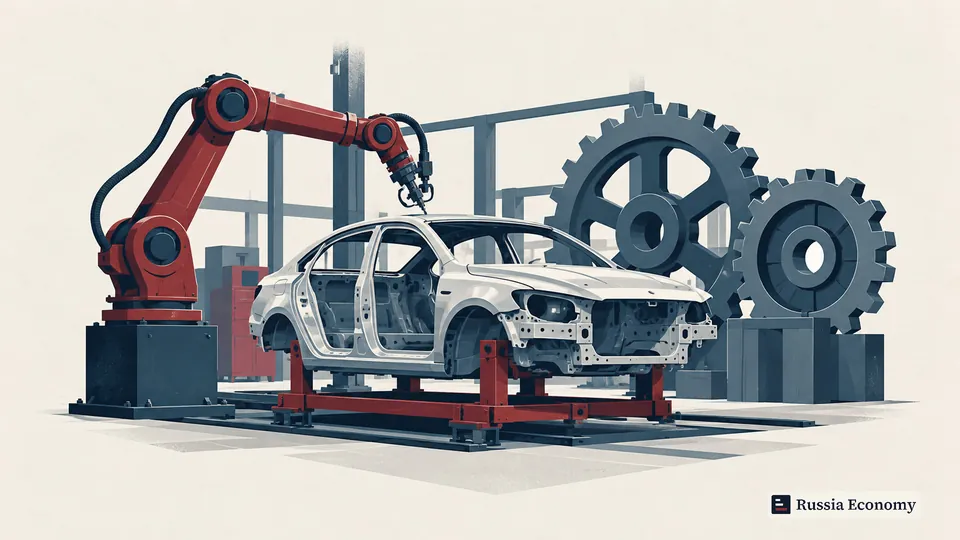
Russian industry combines resource extraction, civilian manufacturing, defense-related production and essential utilities. Their fortunes can diverge sharply. A factory supported by state orders may expand while a producer dependent on household purchases or private investment cuts output. The aggregate industrial index cannot show that distinction on its own.
Rosstat reported that industrial production was unchanged in January to August 2026 from the same period of 2025, while manufacturing rose 0.4 percent. Its September 23 release therefore described a much flatter overall picture than the phrase industrial boom would suggest. The central issue is which activities are growing, what supports them and whether that growth builds productive capacity elsewhere in the economy.
What industrial production actually measures
Rosstat's August industrial-production release groups industry into mining and quarrying, manufacturing, electricity and related energy supply, and water, waste and related services. Manufacturing is consequently a major component of industry, not a synonym for the entire industrial sector. Oil extraction and oil refining, for example, sit in different activities.
The index seeks to measure changes in production volume rather than the increase in current-ruble sales. Rosstat's September 2026 release uses representative products and 2023 base-year prices in its calculation. Rising prices alone should therefore not be read as an equivalent increase in physical industrial activity.
That does not make the index a direct measure of quality, profitability or technological sophistication. Producing more units can raise an output measure even if production requires expensive imported inputs or heavy financial support. A newly assembled product and a domestically designed system can contribute to measured manufacturing while embodying different capabilities.
Timing matters as well. Rosstat reported an August 2026 industrial decline of 0.6 percent from August 2025. A single month's annual comparison and the cumulative January to August comparison answer different questions. Neither should be substituted for seasonally adjusted monthly momentum, which attempts to account for recurring calendar and seasonal patterns.
State orders and civilian demand pull in different directions
Russia's full-scale invasion of Ukraine, launched in February 2022, increased the importance of war-related demand in interpreting manufacturing. Orders connected with the war affect direct producers and suppliers of materials, components and services. Their financing and demand conditions can differ from those facing companies that rely on consumers or private capital spending.
The Bank of Finland Institute for Emerging Economies, BOFIT, highlighted that divergence in its July 31, 2026 review. Using Rosstat data, it reported growth of 32 percent in other transport-equipment production in January to June 2026 from a year earlier. Computer, electronic and optical production increased 4 percent over the same period. BOFIT identified military-related industries as the principal support for manufacturing growth.
The classification requires care. Other transport equipment and electronic products include civilian as well as military uses. Their entire output cannot be counted as weapons production. BOFIT's description is an analytical grouping of industries associated with the war, not a separately published Rosstat total for defense output.
The civilian comparison can look markedly weaker. BOFIT's January 16, 2026 review reported that machinery and equipment production fell 6 percent in January to November 2025 from a year earlier, while electrical-equipment production fell 5 percent. These are explicitly different periods from the first-half 2026 figures, but they illustrate why an aggregate manufacturing increase can conceal weakness in investment-related goods.
State orders can sustain jobs, utilization and supplier demand. They do not by themselves establish how much production would find buyers at prices covering full costs without that support. Understanding the federal budget is therefore part of understanding industrial demand, especially where procurement commitments shape factory plans.
Autos show why the comparison base matters
The car industry makes the distinction between recovery and scale particularly clear. BOFIT's January 16, 2026 review described passenger-car production in late 2025 as still below half its pre-invasion level. Recovering from a disrupted production base can subsequently generate large percentage increases without restoring the former scale or product range.
Rosstat data reported by Interfax on September 23, 2026 put August passenger-car output at 62,600 vehicles, up 69.1 percent from August 2025. Interfax explained that the comparison was affected by manufacturers' corporate holidays in the earlier month. The size of the annual increase therefore partly reflected when factories were operating, not simply a sudden expansion in sustainable capacity.
For January to August 2026, the same report put passenger-car output at 507,000 vehicles, up 13.3 percent from the corresponding period of 2025. Truck production, by contrast, fell 4 percent over that cumulative period. Even neighboring branches of the vehicle industry were following different paths.
Production and sales must also be separated. Sales can include imported vehicles or cars produced earlier and held in inventory. Factory output can rise while inventories accumulate. Neither a strong sales month nor a factory reopening is sufficient evidence that the whole production chain is operating competitively.
Brand ownership adds another layer. A vehicle assembled in Russia contributes to domestic manufacturing whether its brand is Russian or foreign. That does not reveal where its engine, electronics, software or production equipment originated. Measuring localization requires information about inputs and processes, not just the location of final assembly.
What import substitution can and cannot establish
Import substitution is a policy objective with several possible meanings. It can mean replacing a finished imported product with local assembly, making more components domestically, developing the underlying design, or building the equipment used to manufacture it. Progress at one stage does not automatically establish progress at all the others.
The Russian government's February 24, 2025 announcement of the Means of Production and Automation national project described goals of technological independence in advanced machine tools and greater industrial robotization. These are official policy goals. They should be evaluated against subsequent output, use and performance data rather than treated as completed achievements because a program exists.
A new domestic supplier can reduce dependence on an individual foreign company. Yet its factory may still need imported controls, bearings, specialized materials or software support. Replacing one supplier with another foreign supplier can improve continuity while leaving a different external dependency. Both changes can be commercially useful without being equivalent to technological independence.
The most informative evidence concerns repeatable production at the required quality and cost. Deliveries, maintenance capability, reliability and the ability to expand output matter alongside a product launch. A pilot batch establishes less than sustained production with customers willing and able to purchase the result.
There is also a productivity question. If local replacement costs more or requires more labor to provide the same function, it may preserve supply while reducing efficiency. If new processes improve performance and diffuse to other factories, the benefit can extend beyond replacing imports. The policy label alone cannot distinguish those outcomes.
Capacity depends on workers, finance and infrastructure
Factories need labor as well as machines. Competition for skilled staff can raise costs and delay expansion, even where orders are available. The relationship between labor shortages and wages matters because hiring more people is not always a practical route to higher output. Training, automation and changes in organization can take time to deliver results.
Financing creates another constraint. The key rate and borrowing costs influence the expense of working capital, equipment purchases and customers' credit. A business may be capable of producing more but face weaker demand when buyers cannot finance a vehicle or a capital investment. Subsidized or state-funded orders may follow a different path from ordinary commercial credit.
Infrastructure can interrupt production independently of underlying demand. The Bank of Russia's August 5, 2026 discussion summary described damage to oil refineries, reduced petroleum-product output and transport constraints. It also identified higher logistics costs and supply disruptions affecting other industries. Those observations concern specific operating constraints, not a measure of every factory's performance.
The ability to obtain inputs and reach customers connects manufacturing with exports and changing trade routes. A plant can maintain physical output yet receive less income after transport and other costs. Conversely, higher selling prices can improve revenue without any increase in production volume. Output and financial results need separate examination.
What the published data leave unresolved
Rosstat's August 2026 industrial commentary explicitly withholds information on petroleum-product production under a government decision. Restricted detail limits the ability to check contributions inside the aggregate index. It does not justify assigning every unexplained movement to defense production or filling missing categories with invented estimates.
Official series can also be revised when fuller reports arrive or methods change. A later estimate for the same period may differ from the first release. Comparisons should preserve the vintage and classification, particularly when a historical index is rebased. Revisions require explanation, but they are not inherently evidence of falsification.
The autumn review of economic activity places industrial output alongside the wider economic picture. For manufacturing itself, the strongest assessment combines product volumes, orders, employment, financial results and investment. That makes it possible to distinguish sustained civilian capacity from a temporary rebound, and measured production from an official aspiration for the industry's future.
Sources
- Rosstat, Industrial production indices, August 2026 (2026-09-23)
- Rosstat, Dynamics of industrial production in August 2026 (2026-09-23)
- Rosstat, Industrial production index: statistical methodology
- Bank of Finland Institute for Emerging Economies (BOFIT), Russia's economic development has weakened in many sectors (2026-01-16)
- Bank of Finland Institute for Emerging Economies (BOFIT), Weak first half for Russian economy; EU expands sanctions (2026-07-31)
- Interfax, Russian passenger-car output jumped in August 2026 against a low comparison base (2026-09-23)
- Government of the Russian Federation, Means of production and automation national project announcement (2025-02-24)
- Bank of Russia, Summary of the key rate discussion, August 5, 2026 (2026-08-05)
- Bank of Russia, Summary of the key rate discussion, September 23, 2026 (2026-09-23)
Figures come from the listed sources for the dates and periods stated and may be revised.