
NewsBusiness
Russian Railways' October freight loading falls 1.4% as haul distances grow
Loading slipped to 95.6 million tonnes, while freight turnover rose 2.5%, showing how longer journeys can lift transport activity without more cargo.
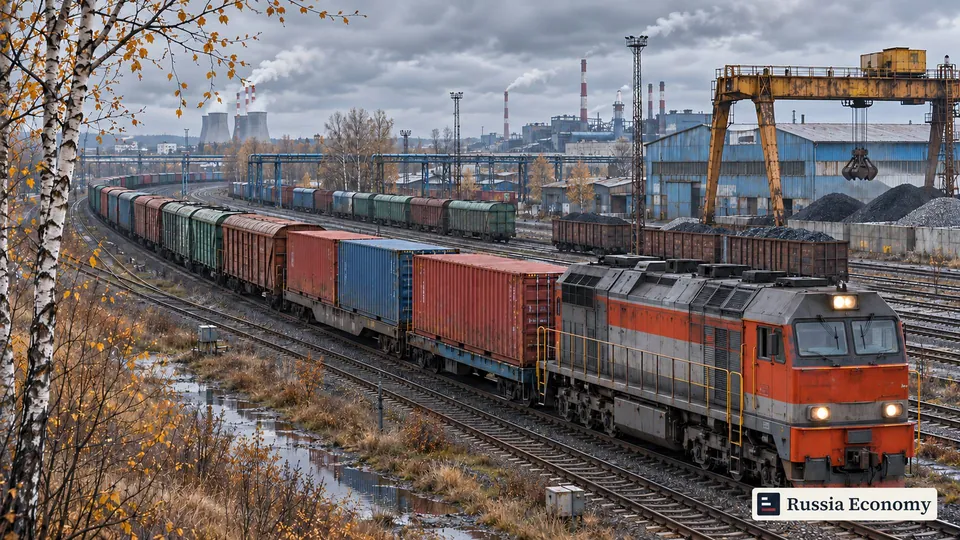
Russian Railways loaded 95.6 million tonnes of freight in October 2026, down 1.4% from a year earlier, according to company figures reported by Interfax on November 2. Yet freight turnover increased 2.5% to 218.3 billion tariff tonne-kilometres.
The two indicators moved in opposite directions because they measure different things. Loading counts cargo weight; turnover also reflects the distance that cargo travels. RZD attributed the divergence to a redirection of freight flows and longer journeys, while linking the decline in loading to external factors.
Less cargo, more transport work
The October figures therefore describe a network carrying slightly less weight over a greater aggregate distance. They do not establish that demand for goods increased by 2.5%, or that railway revenue grew at the same pace.
Including empty wagon movements, October turnover rose a more modest 0.5% to 265.6 billion tonne-kilometres. That separate measure includes activity needed to reposition wagons as well as loaded transport. Keeping it apart from tariff freight turnover avoids treating every kilometre of railway operation as movement of saleable cargo.
Interfax's November 2 report provides the company figures and RZD's explanation. The release does not quantify how much of the change came from each individual route.
Metals improved during October
Several industrial cargoes recorded strong year-on-year growth in October. Loading of ferrous metals increased 8.7%, non-ferrous ore 9.8%, coke 21.1% and metal scrap 22.5%. Cement shipments rose 9%, while chemicals increased 9.4%.
Those gains did not lift total loading above the previous October. They show a mixed cargo market rather than a uniform decline across every commodity.
The comparison period matters. October's 8.7% increase in ferrous metals coexisted with a 7% decline over the first ten months of the year. A stronger month does not erase the accumulated shortfall. The site's guide to Russian industry explains why different industrial segments can move in different directions.
Oil and grain pulled the annual totals apart
Across January to October, total loading declined 0.8% to 920 million tonnes. Coal reached 273 million tonnes, up 1.6%, while oil and petroleum products fell 7.9% to 150.5 million tonnes.
Grain was a notable counterweight: loading increased 34.7% to 27.4 million tonnes. Building materials declined 3.4% to 82 million tonnes, and chemical and mineral fertilizers fell 1.7% to 57.5 million tonnes.
These are railway shipment figures, covering cargo on the network. They are not interchangeable with national production or customs export totals. Grain transported by rail, for example, cannot simply be counted as grain exported abroad. The site's export overview separates the wider commodity categories.
The ten-month picture remains uneven
Tariff freight turnover for the first ten months rose 1.1% to 2,086.3 billion tonne-kilometres. The measure including empty wagon movements was unchanged at 2,561.2 billion tonne-kilometres.
October thus continued the broader pattern: a small decline in loaded tonnes alongside growth in distance-weighted freight work. For companies planning deliveries, the release's main message is the changing composition and geography of transport. It supplies evidence of longer journeys, but no route-specific delivery-time or transport-cost forecast.