
NewsBusiness
Stoik links planned sauce-production expansion to housing for incoming workers
A Novgorod regional report describes two planned production lines and completed employee apartments. The capacity target is separate from output already achieved.
Production plans bring a recruitment question
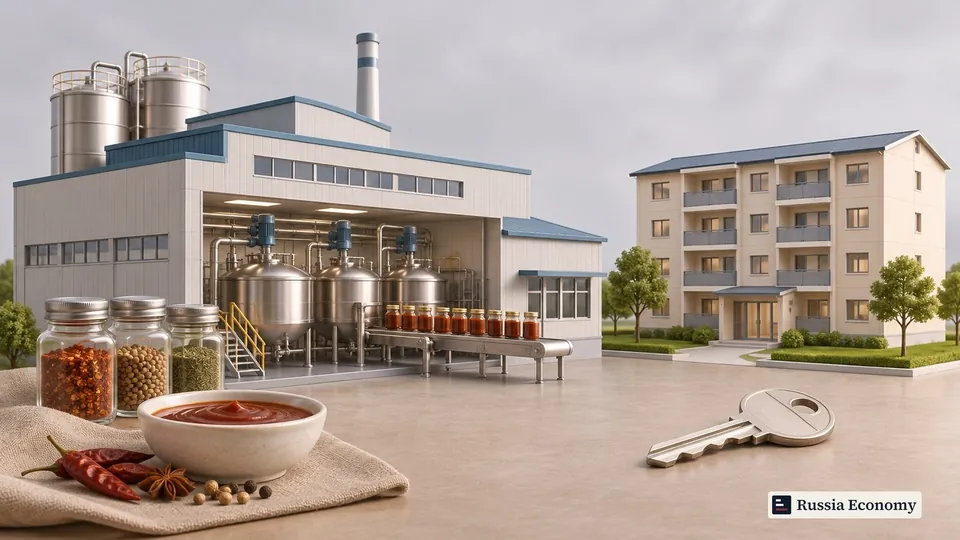
Stoik, a seasoning and food-ingredient producer in Russia’s Novgorod region, plans two marinade and sauce lines with combined capacity of 3,200 tonnes a year. Governor Alexander Dronov described the expansion alongside employee housing, according to November 21 reports by Novgorodskie Vedomosti and Pressa 53.
The announcement concerns the Malovishersky district. It presents additional production and recruitment as plans; it does not establish that the new lines are operating or that their annual capacity has already been reached.
Housing is already part of the offer
Novgorodskie Vedomosti, citing Dronov, reports that two houses containing four apartments have been built. One apartment was provided to laboratory employee Anastasia Yurganova, who moved from Luga after graduating. The report does not specify whether the arrangement transfers ownership, charges rent or depends on continued employment.
Those distinctions matter when assessing an employer’s housing offer. A completed apartment is a tangible recruitment resource, but its value to a worker also depends on the occupancy terms. The published account does not provide those terms or the construction cost.
The company describes a local hiring constraint
Pressa 53 attributes a more specific explanation to general director Alexei Pogrebtsov: 98% of the workforce is local, while the local specialists the company needs are already employed. The business therefore plans to recruit from other regions and build more housing.
That is management’s assessment of its recruitment situation, not a regional labor-market survey. Neither a current total workforce nor a number of additional jobs is supplied in the report; the percentage cannot be converted into an independently established headcount.
Capacity is a target, not a sales result
The reported 3,200 tonnes is the combined annual capacity of the two planned lines, rather than a figure for each line. The announcement gives no commissioning date, investment budget, confirmed orders or expected utilization rate.
The economic connection is nevertheless clear: expanding the production process also requires assembling the workforce to run it. Housing is one component of the company’s stated response. Whether it attracts enough specialists, and how much output the new lines ultimately produce, remain outcomes to measure after implementation.