ExplainerRuble
The digital ruble explained: what launched and how the rollout works
Broader digital-ruble access began in September 2026, but the legal timetable, voluntary use and later bank and retailer deadlines remain separate questions.
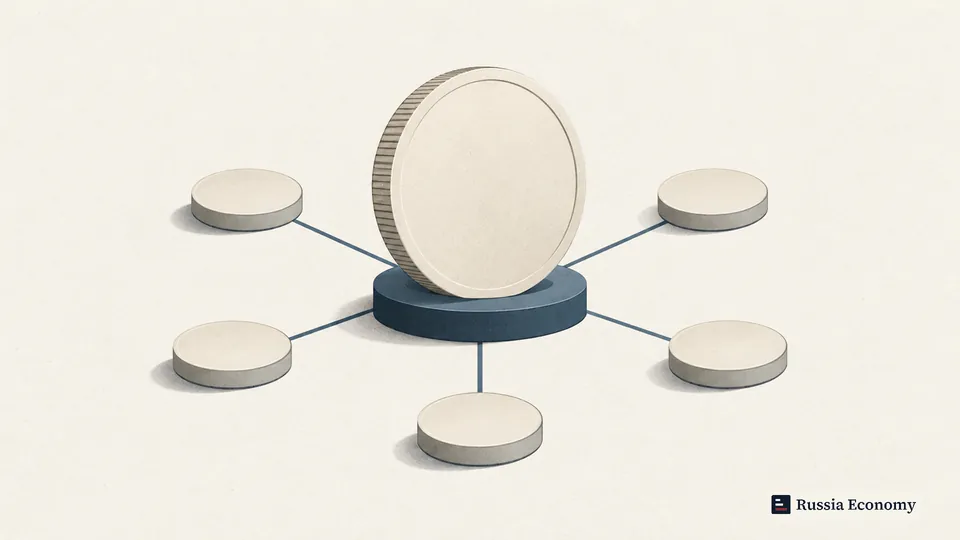
The digital ruble is a form of Russia's national currency issued by the Bank of Russia and held on its platform, with customers accessing it through participating banks. It is distinct from an ordinary commercial-bank deposit, even when both balances appear in the same banking app. It is also distinct from a privately issued crypto asset whose value depends on a separate market.
As of October 17, 2026, broader use had already begun. The Bank of Russia announced access from September 1, 2026, and its project history, updated on September 18, recorded the opening of major banks' and retailers' infrastructure. That was the first stage of a wider rollout. It did not make every bank or shop immediately subject to the same deadline, and individuals remained free to choose whether to use it.
A different claim in the same national currency
The Bank of Russia describes cash, bank-account rubles and digital rubles as equivalent forms of the national currency. Converting between them does not create a new exchange rate. A digital-ruble balance is therefore different from owning a token whose issuer merely promises to track the ruble through reserves or market arrangements.
An ordinary deposit is a claim on a commercial bank. A digital-ruble account sits on the central bank's platform. The bank supplies access and customer services, while the platform records the digital funds. The central bank's public explanation says banks do not dispose of customers' digital rubles as they do funds involved in their ordinary banking business.
The practical interface can conceal that distinction. A person may open a banking app to view both kinds of balances, but the institutional responsibility behind them differs. The design separates the entity providing the interface from the entity issuing and recording the money.
The economic unit nevertheless remains the Russian ruble. A change in the technology used to hold or transfer it does not protect its purchasing power from inflation. It also does not make ruble income equivalent to foreign-currency income or eliminate the role of monetary policy.
The legal foundation preceded the public rollout
The legal framework arrived before broad public access. The Bank of Russia's financial-market development program records that legislation establishing the basis for digital-ruble transactions took effect on August 1, 2023. It also identifies the central bank's digital-ruble platform regulation, dated August 3, 2023, which supplied operating rules.
Federal Law No. 340-FZ, dated July 24, 2023, amended the central-bank framework to establish powers relating to the platform, fees and permitted transactions. The official English text of the central-bank law records those amendments. This gave the Bank of Russia a legal role beyond proposing a technology or running a laboratory demonstration.
A later legislative stage established the broader access timetable. The Bank of Russia's consolidated legal text identifies Federal Law No. 248-FZ, dated July 23, 2025, and provisions applying from September 1, 2026. A statutory deadline for institutions is different from a requirement that an individual hold a new wallet.
The distinction is consequential. Legislation can require a bank to provide access and a retailer to accept a method of payment without compelling a customer to select it. The central bank's September 2026 explanation says accounts are not opened automatically and payments are not converted to digital rubles without the recipient's consent.
From a limited pilot to an operating service
The project advanced through testing before the wider launch. The Bank of Russia's project history records a platform prototype in December 2021 and testing during 2022. Those were development stages, not evidence that the general public could already spend digital rubles.
The central bank's August 9, 2023 announcement scheduled real-money pilot transactions to begin on August 15, 2023, involving 13 banks and a limited group of clients. It described tests of opening wallets, funding them, transfers and purchases. The initial plan included payments at 30 locations in 11 Russian cities.
The Bank of Russia's subsequent history records expanded pilot parameters in September 2024, permitting participation by up to 9,000 individuals and up to 1,200 companies. These were authorized pilot capacities. They should not be reported as a measured count of active customers or as completed national adoption.
Earlier documents anticipated wider use in 2025. The later law and actual September 2026 launch superseded those expectations. A historical statement about what officials expected is useful for tracking the project's development, but it cannot replace the timetable that ultimately took effect.
Which rollout stages apply to banks and retailers
The Bank of Russia's digital-ruble questions and answers, updated on September 1, 2026, describes the following sequence:
| Start date | Institutions covered by that stage |
|---|---|
| September 1, 2026 | Major banks and retailers they serve whose previous-year revenue exceeded 120 million rubles |
| September 1, 2027 | Banks with universal licenses and retailers they serve with annual revenue above 30 million rubles |
| September 1, 2028 | Banks with basic licenses and retail companies with annual revenue from 20 million to 30 million rubles |
Source: Bank of Russia digital-ruble questions and answers, updated September 1, 2026; checked October 16, 2026 UTC.
The same guidance exempts retail outlets with previous-year revenue below 5 million rubles and those operating where there is no internet. The thresholds concern institutional obligations. They do not establish that every customer or every store began using digital rubles on the first day it could do so.
The central bank's launch announcement also said some banks outside the first mandatory group wished to join voluntarily. This means the implementation schedule is a minimum obligation for defined groups, rather than a rule forbidding others from connecting sooner.
As of the article's cutoff, the first stage was in force, while the September 2027 and September 2028 stages remained future requirements. Actual availability for a customer still depends on the bank's connection and supported software. Measured adoption requires activity data, not simply a list of deadlines.
What customers can do with the balance
The Bank of Russia's August 2026 launch decision allows individuals to add up to 300,000 rubles per month from bank accounts to their digital-ruble accounts. It sets no equivalent top-up limit for businesses. This distinction concerns replenishment from bank accounts; it should not be described as a universal maximum wallet balance or a cap on all incoming transfers.
The central bank lists transfers between individuals, business-to-business transfers, purchases, refunds and transfers involving government among the available operations. Users can spend the funds already in their wallets subject to applicable platform rules. An individual or company has one account, while an individual entrepreneur may have separate personal and business accounts.
The launch announcement specifies free payments and transfers for individuals, with a business fee holiday lasting through December 31, 2026. Later business tariffs belong to the next stage of pricing, so a launch-period exemption should not be described as permanent free processing for every user.
The digital ruble pays no interest, according to the central bank's design. Deposits and loans remain products offered by Russian banks. Moving money onto the platform therefore changes the type of claim and the payment options; it is not a way to obtain a new central-bank savings yield.
Why it differs from SBP, cards and cryptocurrency
A bank card and the Faster Payments System are ways to instruct or route payments. They generally work with money in banking accounts. The digital ruble changes where the payment balance itself is held. Similar screens or QR codes do not make the underlying arrangements identical.
This distinction is particularly useful as payment interfaces converge. A merchant can present a QR code through which different payment methods become available. Selecting a bank-account transfer is economically different from transferring funds on the digital-ruble platform, even if the shopper's actions look similar. The guide to Mir cards and SBP explains the existing payment infrastructure.
The comparison with cryptocurrency requires equal care. The defining characteristic here is issuance by the central bank as national money. References to digital technology, cryptography or software do not turn that claim into a decentralized asset. Conversely, describing the digital ruble as ordinary online banking misses the separate platform and issuer relationship.
Its domestic launch also does not demonstrate a functioning international payment corridor. Cross-border use would require compatible institutions, operating agreements, currency arrangements and applicable permissions. Those conditions cannot be inferred from a national rollout announcement.
Smart contracts remain a separate development track
On June 18, 2026, the Bank of Russia published a concept for a platform of commercial smart contracts. It described software that automatically executes transactions when specified conditions are met. The proposal would allow market participants to develop their own scenarios, extending functionality beyond contracts created by the central bank.
The consultation accepted comments through September 30, 2026. The close of that comment period does not prove that the proposed platform had been implemented. Treating every feature in the concept as a service available at the September launch would mix an operating payment system with a separate development proposal.
For analysis, the next meaningful evidence is actual use: active customers, successful payments, merchant acceptance, service reliability and effects on bank funding. The economic timeline separates the legal and operating milestones. Keeping those dates distinct makes it possible to assess the digital ruble as it develops without mistaking a pilot, a deadline or an ambition for the same event.
Sources
- Bank of Russia, Digital ruble launched (2026-08-31)
- Bank of Russia, Digital ruble (2026-09-22)
- Bank of Russia, Digital ruble: questions and answers (2026-09-01)
- Bank of Russia, Digital ruble project history (2026-09-18)
- Bank of Russia, Digital ruble: start of pilot testing (2023-08-09)
- Bank of Russia, Russian Financial Market Development Programme for 2024 to 2026 (2024)
- Bank of Russia, Federal Law on the Central Bank of the Russian Federation, English text incorporating amendments
- Bank of Russia, Large-scale introduction of digital ruble to begin on 1 September 2026 (2025-07-15)
- Bank of Russia, Decision on maximum digital-ruble transaction amounts, operations and provision of access from September 1, 2026 (2026-08-28)
- Bank of Russia, Platform of commercial smart contracts in digital rubles: Bank of Russia concept (2026-06-18)
- Bank of Russia, Digital Ruble: Current Status (2025-06-30)
Figures come from the listed sources for the dates and periods stated and may be revised.