ExplainerBanking
Mir cards and the Faster Payments System: how payments work in Russia
Mir, the Faster Payments System and SPFS perform different jobs, which explains how domestic payments continued after international card networks suspended operations.
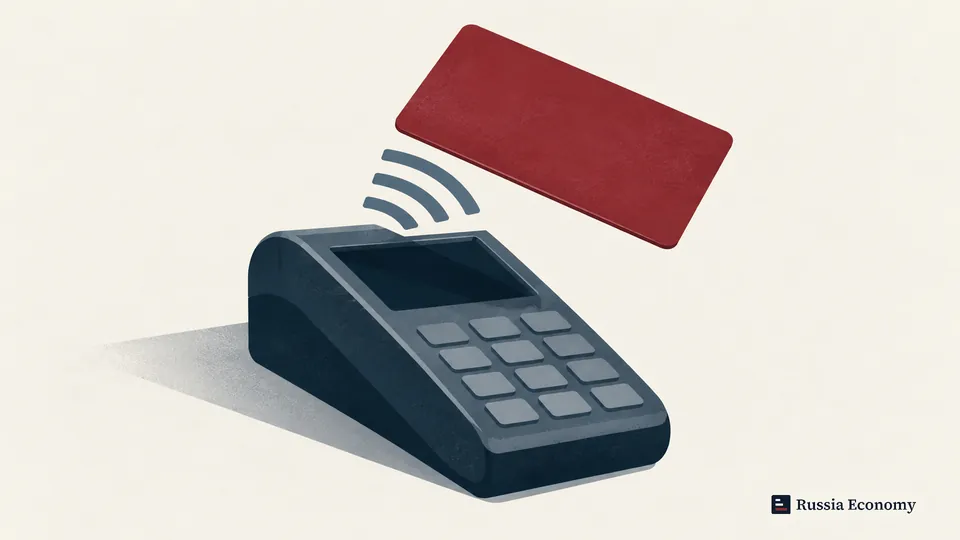
Russia's domestic payment system has several layers. Mir is a card-payment scheme. The Faster Payments System, usually called SBP, moves money between bank accounts and supports merchant payments. SPFS carries financial messages between institutions. Their different roles explain why withdrawing an international service does not necessarily stop an everyday payment inside Russia, while a transfer abroad can still become difficult or impossible.
The Bank of Russia's national-payment-system data put cashless payments at 88.4 percent of retail turnover in the second quarter of 2026. That is a measure of payment value in retail activity, not proof that cash has disappeared or that all customers have equal access to digital services. The infrastructure is extensive, but each payment still needs a working route from payer to recipient.
Mir is a card scheme; NSPK runs infrastructure
Mir operates within infrastructure developed by the National Payment Card System, known by its Russian abbreviation NSPK. The Bank of Russia established NSPK in 2014. Its December 15, 2015 announcement marked the issue of the first Mir cards, after participating banks tested functions such as purchases and cash withdrawals.
A cardholder normally deals with the issuing bank, which maintains the underlying account and sets the customer relationship. A merchant deals with an acquiring bank or payment provider. The payment scheme and processing infrastructure connect those sides and establish how instructions and information travel between them.
That distinction matters when describing ownership of the money. A Mir logo does not turn an ordinary bank-account balance into a direct claim on the central bank. The bank remains responsible for the account. The banking-system explainer sets out the different roles of deposits, supervision and insurance.
The central bank reported 520.6 million Mir cards issued as of July 1, 2026. Issued cards should not be counted as unique people: a customer can have several cards, and issuance figures are not measures of monthly active users. A large card base demonstrates the scale of distribution without measuring how often each card is used.
Why Visa and Mastercard cards continued to work domestically
Visa and Mastercard announced suspensions of their Russian operations on March 5, 2022, following Russia's full-scale invasion of Ukraine, launched in February 2022. The announcements concerned the companies' network services. Domestic processing had already been moved into Russian infrastructure, creating a distinction that initially caused considerable confusion.
Visa said Russian-issued cards would cease working outside Russia once its suspension was implemented, while cards issued abroad would cease working within Russia. Mastercard described the withdrawal of its own network support and subsequently clarified that Russian domestic transactions ran through the local switch, outside its control.
The Bank of Russia's March 6, 2022 explanation said Visa and Mastercard cards issued by Russian banks would continue domestic transactions through NSPK. Customers could retain access to their account funds even though the international connection stopped. The card's brand and the system actually processing the payment were no longer necessarily the same.
This explains a payment outcome, not a universal guarantee for every old piece of plastic. An individual card's status depends on its issuing bank, validity and service conditions. The historical fact that domestic processing survived cannot establish that a particular card issued before 2022 is usable in October 2026.
The separation is also why the suspension should not be described as eliminating Russian electronic payments. Equally, continued purchases inside Russia did not restore international acceptance. Domestic resilience and lost cross-border functionality occurred together, as the wider account of sanctions and Russia's economy explains.
SBP moves money without a conventional card purchase
The Faster Payments System launched on January 28, 2019, initially with limited access while participating banks adjusted their systems. The Bank of Russia is its operator and settlement center; NSPK supplies operational and clearing functions. It supports transfers using a phone number and payments initiated through QR codes or other supported interfaces.
With a person-to-person transfer, the phone number helps identify an account and receiving bank. It is not a separate store of money. Both banks need to participate, and the customer confirms the recipient and amount through a banking channel. With a merchant purchase, the payment can move directly between bank accounts without using the ordinary card-acquiring route.
The Bank of Russia recorded 223 participating banks as of September 1, 2026. Its national-payment-system overview describes SBP alongside card infrastructure, rather than treating one as a synonym for the other. Customers can use both channels through the same bank.
Annual activity shows how far SBP has expanded beyond its initial transfer function. The central bank reported 18.3 billion SBP transactions worth 103 trillion rubles in 2025. Payments for goods and services exceeded 5 billion during that year. The total includes transfers, so it must not be presented as the value of retail purchases alone.
Moving money between a person's own accounts can increase payment-system turnover without representing new consumption. Repeated transfers of the same funds can also create multiple transactions. These are ordinary features of payment statistics, but overlooking them produces misleading comparisons with retail sales or gross domestic product.
Lower fees and easier switching change competition
Different payment routes involve different charges for banks, merchants and customers. A merchant's payment-processing cost is not necessarily the fee shown to a shopper. Banks can also attach commercial incentives to particular services. Comparing systems requires identifying whose cost is being measured and which type of transaction is involved.
A dated example is the rule introduced on May 1, 2024. The Bank of Russia explained that individuals could make qualifying transfers of up to 30 million rubles per month between their own accounts at different banks without fees. The covered channels included bank apps, online banking and SBP phone-number transfers. The rule excluded branch transactions and transfers addressed to a card number.
The central bank presented this change as a way to improve competition and reduce the need to withdraw cash merely to redeposit it elsewhere. The underlying economic mechanism is straightforward: reducing the cost of moving savings can make it easier for depositors to respond to different terms offered by banks.
A common QR interface can simplify the checkout experience, but the visible code does not settle every question about the payment. The selected route determines the account debited, applicable conditions and handling of a refund. Reading every QR payment as an SBP transaction would therefore become increasingly inaccurate as other payment methods use similar interfaces.
SPFS communicates instructions between institutions
SPFS, the Bank of Russia's Financial Messaging System, operates at a different level. According to the central bank, it exchanges electronic messages relating to financial transactions and supports several message formats. Its function is closer to institutional communication than to a consumer card or shopping app.
The Bank of Russia explicitly notes that participating institutions need correspondent relationships to use the service effectively. A message can tell a bank to make a payment, but the message alone does not supply funds, foreign currency, an eligible account or permission to transact.
This limits the claim that SPFS simply replaces SWIFT in every respect. Both can help communicate financial instructions. The usefulness of either connection depends on the institutions at the other end and on the settlement arrangements supporting the transaction.
Regulation also affects those connections. In its June 24, 2024 sanctions package, the Council of the European Union announced restrictions on EU entities outside Russia connecting to SPFS and on transactions with specifically listed users outside Russia. Those measures concern defined entities and activities. They should not be reduced to a technical compatibility question.
Cross-border access depends on more than the payment brand
Mir's domestic reach does not create automatic acceptance abroad. A foreign acquiring bank must support the relevant route and remain willing and legally able to process it. Acceptance can vary between banks, merchants and locations within the same country. A country appearing in an old announcement is not sufficient evidence of present-day availability.
On February 23, 2024, the U.S. Treasury designated NSPK, the operator of Mir. That is a specific sanctions action against infrastructure. It helps explain why a functioning Russian card scheme can face obstacles outside Russia without implying that every domestic transaction stopped.
Cross-border transactions also involve currency conversion and correspondent banking. The quoted exchange rate, the bank's conversion rate and the amount received can differ because they represent different stages and charges. The ruble explainer explains why an official rate is not a promise of the retail rate available for a particular transfer.
The digital ruble adds another distinction. The Bank of Russia announced broader access from September 1, 2026 through participating banks, but that domestic launch does not itself establish an international settlement network. Its design as central-bank money is explained in the digital-ruble explainer.
For understanding any payment, the useful questions are concrete: where is the money held, which institutions process the instruction, what system settles it, and can the recipient's institution accept it? Mir, SBP and SPFS answer different parts of that chain. Their expansion has strengthened domestic payment capacity while leaving the conditions for crossing a border a separate problem.
Sources
- Bank of Russia, National Payment System (2026-10-01)
- Bank of Russia, Payment card Mir and commemorative coin (2015-12-15)
- Visa, Visa Suspends All Russia Operations (2022-03-05)
- Mastercard, Mastercard statement on suspension of Russian operations (2022-03-05)
- Bank of Russia, Visa and MasterCard payment cards continue to operate as normal in Russia (2022-03-06)
- Bank of Russia, Faster Payments System (SBP) (2024-08-07)
- Bank of Russia, Faster Payments System: project launch (2019-01-28)
- Bank of Russia, Number of companies accepting SBP payments reaches three million (2026-02-06)
- Bank of Russia, Money transfers of up to 30 million rubles per month between individual's accounts become fee-free from 1 May (2024-04-27)
- Bank of Russia, Financial Messaging System of the Bank of Russia (SPFS) (2025-02-13)
- Council of the European Union, Russia's war of aggression against Ukraine: comprehensive EU's 14th package of sanctions cracks down on circumvention and adopts energy measures (2024-06-24)
- U.S. Department of the Treasury, On Second Anniversary of Russia's Further Invasion of Ukraine and Following the Death of Aleksey Navalny, Treasury Sanctions Hundreds of Targets in Russia and Globally (2024-02-23)
- Bank of Russia, Digital ruble launched (2026-08-31)
Figures come from the listed sources for the dates and periods stated and may be revised.