
NewsBusiness
Russia's October manufacturing PMI edges up to 49.9
Factories remained in marginal contraction as weaker export orders contrasted with slower declines in output, employment and new business.
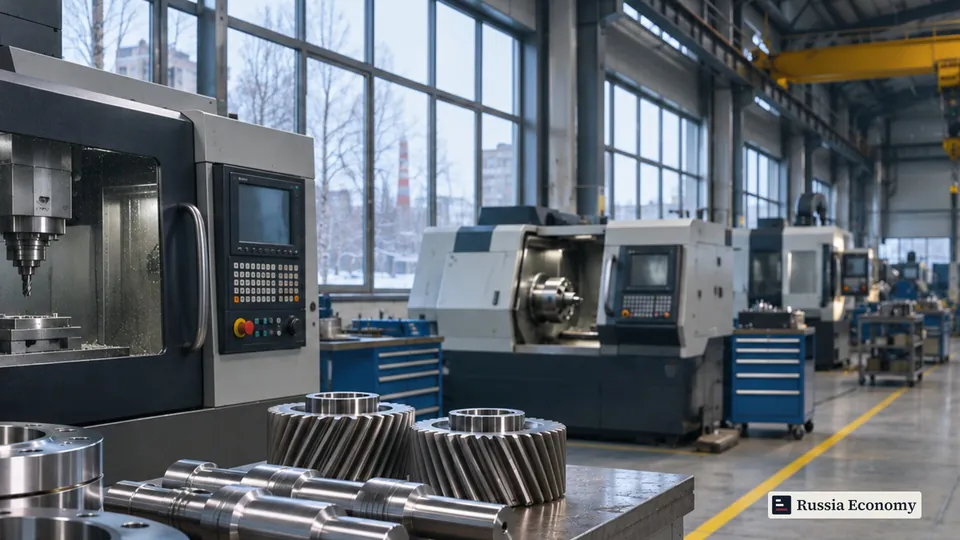
Russia's manufacturing sector remained just below the growth threshold in October 2026, with the S&P Global purchasing managers' index rising to 49.9 from 49.8 in September. The November 2 survey release, reported by Reuters and Interfax, points to near stabilization, rather than a renewed sharp downturn. Output, new orders and employment still declined, but their contractions eased.
A reading below 50 indicates deteriorating operating conditions relative to the previous month. Moving closer to that threshold means the deterioration was less widespread on the survey's composite measure; it does not establish a return to expansion.
Orders remained the weak point
Reuters reported that production and total new orders fell for a third consecutive month, with both declines marginal. Survey respondents cited competition, subdued demand and reduced customer purchasing power as constraints on new business, according to Interfax. These are businesses' explanations of their experience, not a statistical decomposition of the causes of Russia's industrial performance.
The export picture was weaker. Reuters said new export orders declined for a twelfth consecutive month and at the fastest pace since May 2022. Respondents linked this to fewer orders from other Commonwealth of Independent States markets, especially Kazakhstan. The survey does not provide a customs-based measure of export volumes or establish that all Russian manufacturing exporters faced the same conditions.
The different signals matter. A headline close to 50 can coexist with a much sharper deterioration in one part of demand. Treating the composite as evidence that every component stabilized would miss the export weakness. Conversely, treating the export response as the rate of decline in all factory activity would exaggerate what the survey measures.
Employment adjusted as unfinished work declined
Employment fell again in October, although the reduction was the slowest recorded so far in 2026, Reuters reported. Firms described layoffs and voluntary departures. Backlogs of work declined for a twenty-first month, indicating that outstanding business continued to be worked through rather than replenished sufficiently to increase the survey measure.
Purchasing activity also weakened as firms used stocks already on hand. This combination is consistent with cautious production planning: businesses can fulfill existing orders while reducing fresh input purchases. That is Russia Economy's interpretation of the joint signals, not a separately measured contribution to national output.
A manufacturing employment survey cannot substitute for Russia's household unemployment statistics. The former asks sampled factories about changes in their workforces; the latter measures people across the labor market. Our labor market guide explains why low national unemployment can coexist with reductions at individual employers or in particular industries.
Costs rose while price increases became harder
Interfax reported that higher material costs and supplier charges continued to raise manufacturers' input costs. The pace of input inflation nevertheless eased to a seven-month low. Selling-price inflation also slowed, reaching its weakest pace since April as competition limited companies' pricing room.
Slower inflation in these survey measures means prices were rising less rapidly, not that they fell. Nor do the qualitative results quantify a change in profit margins. A margin calculation would require information on actual selling prices, input costs, productivity and sales volumes, which the headline release does not supply.
Business expectations improved to their strongest level since June, Reuters reported, with respondents hoping for a steadier market and new customers. Expectations describe anticipated output, while the production index describes reported current changes. The improvement in confidence therefore does not cancel the October decline in output or guarantee a subsequent recovery.
What 49.9 can and cannot tell readers
S&P Global's explanation of the headline PMI and its components describes a composite built from orders, output, employment, supplier delivery times and purchased stocks. Price indicators are separate. Delivery times enter with an inverted sign, one reason the headline should be interpreted alongside its components.
The public reporting retrieved for October provides directions and relative speeds for the components, but not their exact index readings. No numerical output, orders or employment sub-index is supplied here. The 49.9 headline is an index level, not a 0.1 percent decline in manufacturing production, and its 0.1-point rise is not a growth rate.
The Russian industry explainer places the survey alongside the wider production economy. October's release supports a precise conclusion: the surveyed manufacturing downturn became marginal, while export demand remained weak and firms continued adjusting staffing and purchasing. It does not establish that every industrial segment recovered or predict the next interest-rate decision.